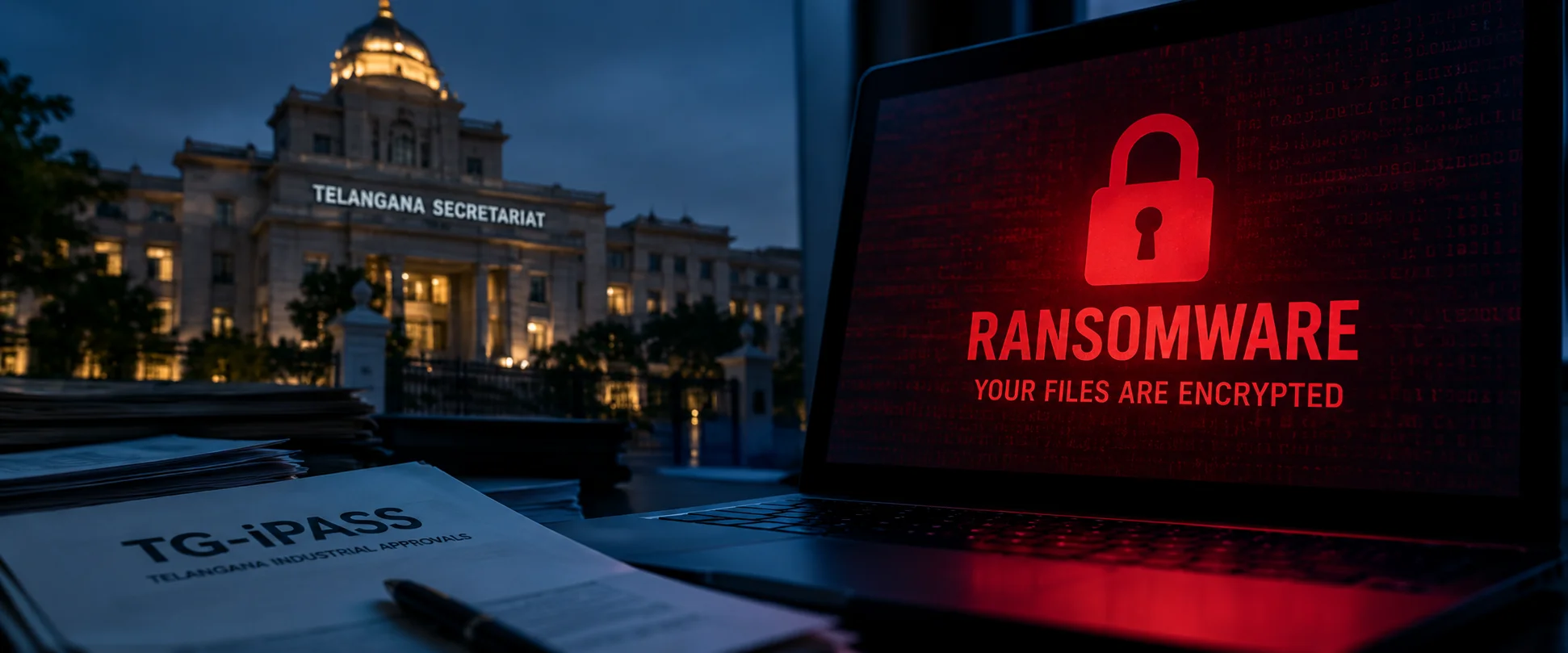
Telangana Covernment Portal Crippled by Ransomware Attack
A suspected ransomware attack disrupted Telangana’s industrial approvals portal, raising questions about database security, incident response, and disaster recovery preparedness.
A Government Portal Goes Offline
The Telangana ransomware attack disrupted the TG-iPASS portal, raising concerns about government service availability, database security, and recovery preparedness. The suspected attack reportedly encrypted the database and related files, leaving the industrial approvals platform unavailable. The incident highlights why organizations need effective access controls, isolated backups, and tested incident response procedures.
On October 22, 2026, Telangana’s State Industrial Project Approval and Self-Certification System (TG-iPASS) reportedly went offline after its application could no longer connect to its database server. A subsequent inspection indicated that the server had been compromised and that its database and related files had been encrypted.
According to a report by The New Indian Express published on October 25, officials found files carrying an unfamiliar .vgb extension and a ransom note on the affected server. The available evidence led officials to suspect a ransomware attack. A complaint was filed with the Telangana Cyber Security Bureau, and an investigation was initiated.
TG-iPASS serves as a single-window platform for businesses seeking industrial approvals and related government services. Its disruption therefore raises an important question: how resilient are the digital systems that businesses depend on to operate?
Source: The New Indian Express — TG-iPASS portal fails ransomware attack test
What Happened?
The reported sequence of events illustrates how a security incident can quickly become an operational outage.
Initially, the application failed to connect to its database. Attempts to restore the affected service did not resolve the problem. Further inspection indicated that the SQL Server Agent service had stopped and that the database and associated files had been encrypted.
The discovery of encrypted files and a ransom note strengthened suspicions of ransomware.
Ransomware is malicious software that prevents an organization from accessing its systems or data, commonly by encrypting files. Such incidents can interrupt services even when the underlying infrastructure remains physically intact.
However, several important questions remain unanswered:
1. How did the attackers gain access to the environment?
2. Did they obtain administrative or privileged access?
3. Was any information copied out of the environment before encryption?
4. Were the backups accessible to the attackers?
5. How long will complete service restoration take?
These questions require evidence from forensic investigation. The available reporting does not establish the initial entry point or confirm that data was stolen.
Why This Incident Matters
1. Availability is a security requirement
Cybersecurity is not limited to preventing information theft. Applications must also remain available to legitimate users.
When a business-facing government portal becomes unavailable, organizations may experience delays in submitting applications, tracking approvals, or completing administrative processes. The extent of the actual business impact in this incident has not yet been established.
For organizations operating critical services, availability should be treated as a measurable security objective, supported by tested recovery procedures and realistic restoration targets.
2. Backups must survive the incident
Maintaining backups is necessary, but simply having backup files does not guarantee recovery.
If attackers can access and encrypt production data as well as connected backups, the organization may lose both its primary systems and its recovery options.
Organizations should maintain isolated or immutable backups, restrict backup administration privileges, and regularly test restoration procedures. Recovery testing should verify data integrity and application functionality—not merely confirm that files can be copied back.
3. Database security requires layered protection
Database servers should not be treated as trusted simply because they operate inside an internal network.
Organizations should restrict administrative access, separate application and database privileges, monitor unusual service changes, and maintain audit logs that can support investigations. Access to backup infrastructure should also be separated from routine application administration wherever practical.
4. Incident response must preserve evidence
The reported response included requests to isolate affected systems and preserve logs and disk images for forensic analysis.
These steps matter because restarting, rebuilding, or restoring a compromised server without preserving evidence can destroy information needed to determine how the incident occurred.
A disciplined response should balance containment and recovery with evidence preservation, particularly when unauthorized access and possible data exfiltration remain under investigation.
What Organizations Should Review
1. The TG-iPASS incident provides a useful checklist for security and infrastructure teams:
2. Verify that production and backup environments have separate access controls.
3. Test recovery from clean backups in an isolated environment.
4. Review database and operating-system administrative privileges.
5. Centralize security logs and protect them against unauthorized modification.
6. Monitor unexpected encryption activity, suspicious file extensions, and ransom-note creation.
7. Document incident containment, evidence preservation, and recovery responsibilities.
8. Establish and test recovery time and recovery point objectives.
9. Validate restored data and application integrity before returning services to production.
These controls reduce risk, but no single control guarantees protection against ransomware.
What We Know—and What Remains Unknown
As of the October 25 reporting, the available evidence points to a suspected ransomware attack that encrypted the TG-iPASS database and associated files, leaving the application and database unavailable.
The reported investigation was intended to establish the attack vector, determine whether information had been exfiltrated, identify indicators of compromise, and validate clean backups.
Until those findings are published, it would be premature to attribute the incident to a particular threat group or claim that sensitive information was stolen.
The Bigger Lesson
The TG-iPASS incident demonstrates why cybersecurity must include resilience, not just prevention.
Firewalls, endpoint protection, access controls, and vulnerability management remain essential. But organizations also need the ability to detect destructive activity, isolate compromised systems, preserve evidence, and recover from verified clean backups.
For any organization delivering critical digital services, the real test of security is not only whether an attack can be prevented. It is whether the organization can contain the damage and restore trustworthy services when prevention fails.


Comments
No comments yet — start the conversation.